


Key Takeaways
- Marketing now relies heavily on metrics; measuring them is crucial for improvement.
- Key performance indicators (KPIs) provide insights into business growth and overall health.
- Every marketer should focus on four essential metrics: brand equity, customer lifetime value (CLV), customer acquisition cost (CAC), and net promoter score (NPS).
- Measuring these metrics helps marketers understand their effectiveness, foster customer loyalty, and increase profitability.
- Overall, choosing the right metrics that every marketer measures is vital for guiding business direction and success.
It’s all about numbers these days. Marketing has never been more number-driven than today. With gut feeling no longer finding a place, marketing success has boiled down to having a thorough understanding of your marketing numbers or metrics.
“If you don’t collect any metrics, you’re flying blind. If you collect and focus on too many, they may be obstructing your field of view”
Scott M. Graffius
The rule here is simple: if you do not measure something, how will you improve and manage it?
According to Google, 89% of leading marketers prefer metrics such as customer lifetime value, market share, and gross revenue to gauge the effectiveness of marketing campaigns.
Selecting the right marketing metrics could be the difference between success and failure.
Marketing metrics, or key performance indicators (KPIs), are designed to analyze growth and measure the overall health of your business. These provide a clear picture of where you stand at the fundamental level.
Some of the benefits of measuring marketing metrics include:
- You make more money
- You know what’s working and what’s not
- Save money and build a reputable brand
- Build trust with your customers
Top 4 key metrics every marketer should measure
Tracking a dozen metrics is like putting feet in muddy waters. You don’t know which will help you sail your business boat to the shore. So, we’ve listed the top 4 metrics every marketer should measure to ensure a profitable and customer-loved business.
1. Brand equity
Did you know 94% of the world’s population recognizes the Coca-Cola logo? That’s the kind of brand equity every brand dreams of achieving.
Brand equity is the value a brand has in the customer’s eyes. It’s the value your brand carries with it, and it’s that element that influences the purchase decision.
But how do you measure it?
Positive brand equity translates to strong value. As it’s a qualitative thing, quantifying it, in general, would be difficult. Measuring brand equity is all about finding the following:
- Brand valuation: The total brand’s value as a separate asset, usually available in the balance sheet.
- Brand strength: It measures a brand’s strength in the mind and market. By measuring consumer demand, you can effectively measure brand strength. It’s usually captured through a survey that asks questions to assess your brand’s relative preference compared to others.
Benefits of measuring brand equity
- Give you a competitive edge: Strong brand equity indicates that your customers prefer your brand over competitors, time and again.
- Increases customer loyalty: It helps you understand the target audience and personalize market efforts across sales channels, resulting in a loyal customer base.
- Enhances shareholder value: As brand equity drives customer value, it improves shareholder value.
- Higher profits: According to research, brand equity plays a significant role in pricing decisions. Customers don’t hesitate to pay more for a brand they perceive as valuable, thereby increasing profits.
- Increases sales: With 43% of customers willing to spend money on brands they’re loyal to, positive brand equity will drive more sales.
Companies to learn from: Apple is a perfect example of a company with positive brand equity as it prioritizes innovation and design. In 2015, Volkswagen saw a steep decline in brand equity after it was accused of falsifying emissions data.
Tool for measuring brand equity: Attest
2. Customer lifetime value (CLV)
Every customer is precious, right? But, in the digital age, some customers are more precious than others. With repeat customers spending three times as much as new customers, you need a metric that effectively helps increase loyalty.
That’s why you measure customer lifetime value (CLV) or the lifetime value (LTV).
CLV is one of the most understated marketing metrics. Failure to measure or track it puts you behind the competitors.
A 5% increase in retention rate increases profits by 25% to 95%. This makes CLV a must-measure metric for marketers.
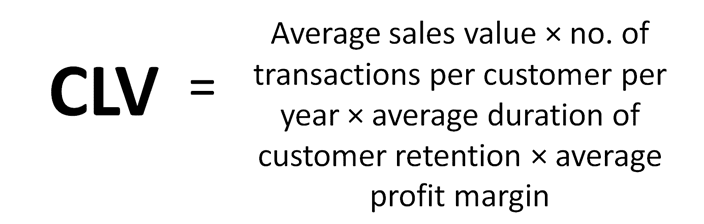
It indicates how well your customers are resonating with the brand, how much they prefer your products, what you’re doing right, and how you can improve. CLV measures the total amount a customer is likely to spend on your brand during their lifetime. It’s the profit margin a company earns over the entire relationship with a customer.
Formula:
Benefits of measuring customer lifetime value
- Encourages brand loyalty: A weaker client relationship implies weaker loyalty and fewer repeat customers. You can foster brand loyalty when you know what’s working with the customers and what’s not. Measuring CLV will help you understand this.
- Accurately judges the product quality: A low CLV value indicates that your customers hate your products. Or they are unaware of the potential benefits. Both cases result in fewer sales.
- Helps in measuring the financial impact of marketing campaigns and other digital marketing strategies
- Helps you strike a balance between the short-term and long-term marketing goals
- Reduces the time you spend on acquiring non-profitable customers
- Helps segment customers based on acquisition and value.
- Increases the overall business profitability
CLV calculator: CleverTap
3. Customer acquisition cost (CAC)
You cannot acquire customers for free. There’s a certain opportunity cost associated with every acquisition. Though growth is excellent, growth at any price is detrimental, as it will do more harm than good.
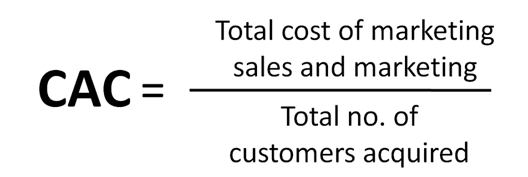
And that’s where CAC comes into the picture. It’s the cost associated with convincing a potential customer to buy your product or service. In other words, CAC is the total marketing and sales costs incurred to acquire a new customer.
Understanding customer acquisition costs is the heart of growing your business profitably and scalably. You cannot afford to overlook this marketing metric. It ensures your company generates sufficient income to cover its operating costs.
A few reasons for high CAC: a poorly structured business model, setting unrealistic expectations, investing in random marketing strategies, and not knowing your customers. For a profitable business, the CAC should be a minimum. Remember that CAC varies from company to company. A $200 CAC may be the minimum, while a $5 CAC would be high for others.
Formula:
As a marketer, based on your industry, strive to achieve a low CAC for a brighter future.
Benefits of customer acquisition cost
- Gives information on the cash efficiency of your business.
- Helps in understanding the business’s success and failure.
- Depicts the effectiveness of a marketing campaign and strategies.
Companies to learn from: Netflix spends roughly $125-$145 to acquire new customers. The marketing cost is $45. The remaining funds are spent on content to reach customers. The CAC of Priceline, a travel company, is $7.
CAC calculator: Funneloverload
4. Net promoter score (NPS)
Another critical marketing metric to track is the NPS. This measures customer loyalty and satisfaction. In other words, it measures the likelihood of repeat business.
For NPS calculation, you ask the customers a single question:
“How likely are you to recommend the company to your friends or colleagues, on a scale of 1 to 10?”
A “1” is not at all likely to be as extreme as a “10,” whereas a “10” is extremely likely to be as extreme as a “1.”
On receiving the customer response, you segment them into three categories:
- Promoters are loyal customers and usually rate 9 or 10.
- Passives are unhappy, but satisfied customers, and usually give a score of 7 or 8.
- Detractors are unhappy customers and usually rate below 7.
Formula:

Benefits of Net Promoter Score
- Increases customer loyalty
- Helps you drive useful insights from customer feedback
- Assists in forecasting business growth and cash flows
Companies to learn from: In 2018, PayPal’s NPS was 63, and Amazon’s was 56.
NPS calculator: SurveyMonkey
Key metrics every marketer should measure
Measuring metrics or KPIs is like a pole star for sailors. They tell marketers like you where you stand. And they tell you where you have to head in the future. You need metrics that provide insight into your brand’s health and clearly show the impact of your marketing efforts.
Just because you ‘can’ doesn’t mean you should. You don’t have to measure or track every possible marketing metric.
Tracking too many data points will quickly make insightful information paralyzing. Therefore, these four metrics are every marketer should measure to boost their business.
Access to quality metrics is key to a marketer’s success. You spend hundreds of dollars on building and promoting a product.
Therefore, it’s crucial to determine whether the efforts are yielding the desired results. Apart from increasing profitability, measuring the right metric prevents your business from heading in the wrong direction.
Understanding key metrics like CLV and brand equity is essential. It will have a significant impact on your bottom line. Every marketer should measure these metrics today.
This guest blog article was written by Priya Jain. She is a freelance writer and a professional blogger. She holds an MBA in Finance and Marketing, as well as a Chemical Engineering degree. You can follow her on LinkedIn.
Join my email newsletter for a free eBook and more helpful insights.